Cart
Cart
|
Home > Online Product Documentation > Table of Contents > Opening Files in Stylus Studio Opening Files in Stylus StudioThis section provides background information about how Stylus Studio opens files and describes the procedure for opening files. This section covers the following topics:
About Opening FilesGenerally speaking, you use the Open dialog box to open a file in Stylus Studio. Stylus Studio can open any type of file. If the file you want to open is not visible in the Open dialog box, change the filter in the Files of type: field. If necessary, click the All Files (*.*) option. There is no limit to the number of files that can be open in Stylus Studio. Standard File TypesStylus Studio automatically recognizes certain file name extensions and can associate them with a specific Stylus Studio module, as shown in Table 2:
In addition to the file name extensions shown here, Stylus Studio can open files that use any file name extensions that you define. See Associating File Type Extensions with Stylus Studio Tools. If you try to open a file that has a file name extension that Stylus Studio does not recognize, Stylus Studio prompts you to specify which module you want to use to view the file.
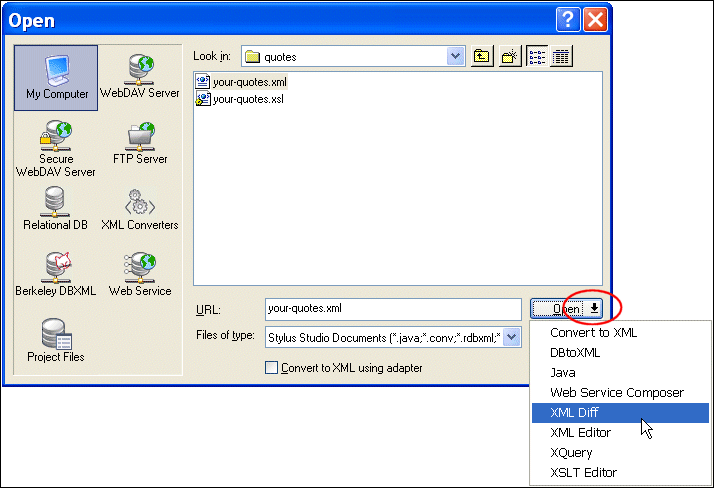
Changing the Default Module When Opening a FileYou can choose to use a Stylus Studio module other than the default module to open a particular file. For example, you might want to open an XSLT stylesheet in the XML Editor, or open an XML file that contains a DTD in the DTD Schema Editor. To change the default module when opening a file, click the down arrow to the right of the Open button and select the module you want to use from the drop-down list as shown in Figure 90.
Opening Files Stored on Berkeley DB XMLStylus Studio provides access XML documents stored on Sleepycat Software's Berkeley DB XML database. See Using Stylus Studio with Berkeley DB XML. How to Open a Locally Accessible FileTo open a locally accessible file:
1. From the Stylus Studio menu bar, select
File >
Open.
The Open dialog box appears.
2. In the
Look in: field, click the down arrow to navigate to the file you want to open.
3. Click the file you want to open.
4. Click the
Open button.
How to Open a File on a WebDAV or FTP ServerTo open a file on a WebDAV or FTP server:
1. From the Stylus Studio menu bar, select
File >
Open.
The Open dialog box appears.
2. In the left pane, click
WebDAV Server
 or
FTP Server
or
FTP Server
 according to the location of the file you want to open. The
Choose Server dialog box appears.
according to the location of the file you want to open. The
Choose Server dialog box appears.
3. Type the name of the server, your user name, and your password, and click
OK.
4. Navigate to the file you want to open and select it.
5. Click the
Open button.
Opening Files from a BrowserYou can drag and drop HTTP, FTP, or file system URLs from Internet Explorer windows into Stylus Studio. If you drag the URL into the Stylus Studio framework, Stylus Studio opens the file. If you drag the URL into the Project window, Stylus Studio adds the file to the project. |

XML PRODUCTIVITY THROUGH INNOVATION ™