Cart
Cart|
Home > Online Product Documentation > Table of Contents > Working with Scenarios Working with ScenariosAs described earlier in this chapter, you use a DB-to-XML data source scenario to specify database connectivity settings. You create and modify DB-to-XML data source scenarios using the Scenario Properties dialog box. This section describes how to open the Scenario Properties dialog box (Stylus Studio opens it for you automatically when you create a new DB-to-XML data source), and how to create new and modify existing scenarios.
This section covers the following topics: Opening the Scenario Properties Dialog BoxThere are two ways to open the Scenario Properties dialog box. Both allow you to work on existing scenarios or to create new ones. To open the Scenario Properties dialog box:
Creating a ScenarioThis section describes how to create a DB-to-XML scenario. Naming Scenarios
Stylus Studio supplies a default name, like
How to Create a ScenarioTo create a scenario:
1. Open the DB-to-XML data source editor if it is not already open.
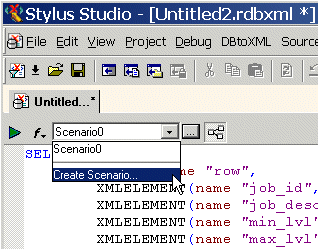
2. Select
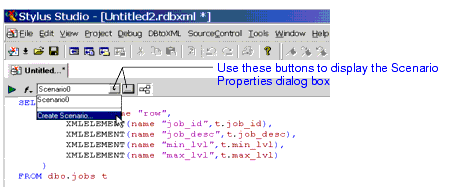
Create Scenario from the scenario drop-down list at the top of the editor window:
Stylus Studio displays the
Scenario Properties dialog box. The name field displays a default scenario name (
3. Change the default scenario name.
4. Specify the connection settings. See
Specifying Connection Settings if you need help with this step.
5. Click
OK to save the scenario with the new settings.
Stylus Studio connects to the server specified in the scenario. AlternativeUse this procedure if the Scenario Properties dialog box is already open. To create a scenario when the Scenario Properties dialog box is already open:
1. Click
New on the
Scenario Properties dialog box.
The name field displays a default scenario name (
2. Change the default scenario name.
3. Specify the connection settings. See
Specifying Connection Settings if you need help with this step.
4. Click
OK to save the scenario with the new settings.
Stylus Studio connects to the server specified in the scenario. How to Modify a ScenarioYou can modify a scenario at any time. Change that you make take effect as soon as you save the scenario. To modify a scenario:
1. Display the
Scenario Properties dialog box by clicking
 in the DB-to-XML data source editor tool bar.
2. In the
Existing scenarios field, click the name of the scenario you want to modify.
3. Change the scenario's properties as needed. See
Specifying Connection Settings if you need help with this step.
4. Click
OK to save the new scenario.
Stylus Studio connects to the server specified in the scenario. How to Clone a ScenarioWhen you clone a scenario, Stylus Studio creates a copy of the scenario except for the scenario name. This allows you to make changes to one scenario and then run both to compare the results. To clone a scenario:
1. Display the
Scenario Properties dialog box by clicking
in the DB-to-XML data source editor tool bar.
2. In the
Existing scenarios field, click the name of the scenario you want to clone.
3. Click
Clone.
The name field displays a default scenario name (
4. Change the default scenario name.
5. Change the source scenario's connection settings as needed. See
Specifying Connection Settings if you need help with this step.
6. Click
OK to save the new scenario.
Stylus Studio connects to the server specified in the scenario. How to Rename a ScenarioTo rename a scenario:
1. Display the
Scenario Properties dialog box by clicking
in the DB-to-XML data source editor tool bar.
2. In the
Existing scenarios field, click the name of the scenario you want to rename.
3. Click
Rename.
The name field displays the scenario name in edit mode.
4. Change the scenario's name.
5. Click
OK to save the new scenario.
Stylus Studio connects to the server specified in the scenario. How to Delete a ScenarioTo delete a scenario:
1. Display the
Scenario Properties dialog box by clicking
in the DB-to-XML data source editor tool bar.
2. In the
Existing scenarios field, click the name of the scenario you want to delete.
3. Click
Delete.
The scenario is deleted from Stylus Studio. |

XML PRODUCTIVITY THROUGH INNOVATION ™