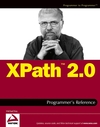
XPath 2.0 Programmers Reference


XPath 2.0 Programmers ReferenceWe're pleased to provide chapter one entitled XPath 2.0 in Context of the XPath 2.0 Programmer's Reference, the only authoritative reference on XPath, a sub-language within XSLT that determines which part of an XML document the XSLT transforms. Written for professional programmers who use XML every day but find the W3C XPath specifications tough to slog through, the book explains in everyday language what every construct in the language does and how to use it. It also offers background material on the design thinking behind the language, gentle criticism of the language specification when appropriate, and a diverse range of interesting examples in various application areas.

XPath 2.0 Programmers Reference covers the following topics:

  • Top-level XPath constructs and the lexical rules for using whitespace and comments
  • Basic XPath operators for writing arithmetic and Boolean expressions
  • Three operators for combining the results of path expressions: union, intersect, and except
  • How XPath 2.0 supports sequences
  • Where to access a complete listing of all functions in the core function library
  • How to define the syntax of XPath regular expressions as used in the new functions matches(), replace(), and tokenize(), and much more

From its origins as a sublanguage of XSLT, XPath has come into its own as a key element of XML. XPath 2.0 has emerged as a robust language twice the size of its predecessor, complex and capable of standing on its own. This substantive volume, by the editor of the W3C® XSLT 2.0 specification, is the authoritative reference on XPath 2.0. It begins by thoroughly explaining the foundations, including XML schema and the evaluation context. Building on this knowledge, it then moves through literals and function calls, basic operators, path expressions, types, and the regular expressions of three new functions that greatly boost the power of XPath 2.0.

Table of contents

  • An Introduction to XPath 2.0
  • Chapter 1: XPath 2.0 in Context.
  • Chapter 2: The XPath Data Model.
  • Chapter 3: The XPath Type System.
  • Chapter 4: XPath Evaluation Context.
  • Chapter 5: Basic XPath Constructs.
  • Chapter 6: XPath Operators on Items.
  • Chapter 7: XPath Expressions.
  • Chapter 8: XPath Sequence Expressions.
  • Chapter 9: XPath Type Expressions.
  • Chapter 10: XPath Functions.
  • Chapter 11: Regular Expressions.
  • Appendix A: XPath 2.0 Syntax Summary.
  • Appendix B: Operator Precedence.
  • Appendix C: Compatibility with XPath 1.0.
  • Appendix D: Error Codes.

Author Biography

Dr. Michael Kay is the author of "XSLT Programmer's Reference" from Wrox Press, the standard reference work on XSLT. He is also the editor of the W3C's XSLT 2.0 specification, which is currently a Last Call Working Draft, and his Java-based Saxon XSLT processor is one of the most successful and popular XSLT processors in the language's history. The branch of Saxon supporting XSLT 1.0 is currently at release 6.5.3, and regular readers of this column will know that the 7.x branch of Saxon has been implementing more and more support for XSLT 2.0, and has also added support for XQuery. Michael recently formed his own company, Saxonica, and has launched a commercial version of Saxon with support for XML Schema Aware XSLT and XQuery processing.

Additional Book Information

Author: Dr. Michael Kay
Paperback: 552 pages
Publisher: Wrox (September 6, 2004)
ISBN: 0764569104

Xalan - Transforming XML with the Apache Xalan XSLT Processor

Apache Xalan is fully supported in Stylus Studio including integrated debugging, executing XSL stylesheets, troubleshooting, previewing XML transformations and more. Build Xalan applications faster and easier then before - Free Download.

XQuery Talk Blog

Get the latest XQuery news and information at XQuery-Talk - an online community for discussing XQuery technologies, examples, implementations and more. Bookmark this RSS or ATOM feed now!

Building Workflow Applications with XML

Learn how to design custom XML workflow applications - from modeling your data and information processes, to capturing input from users in XML, and finally, generating useful queries and reports from the XML data -- using XSLT & XQuery technologies.

Why XQuery - The Case for XQuery

Read "The Case for XQuery" - an article that debuted in the November 2005 issue of SOA WebServices Journal, written by Jerry King, Vice President of DataDirect Technologies.

Stylus Most Wanted

PURCHASE STYLUS STUDIO ONLINE TODAY!!

Purchasing Stylus Studio from our online shop is Easy, Secure and Value Priced!

Buy Stylus Studio Now

Attend a Live Webinar This Week!

Learn about Stylus Studio's unique features and benefits in just under an hour. Register for the Stylus Studio QuickStart Training WebCast!

Why Pay More for XML Tools?

With Stylus Studio® 2008 XML Enterprise Suite, you get the most comprehensive XML tool suite at one incredibly low price. Value: it's just one of many reasons why smart XML developers are choosing Stylus Studio!

Site Map | Privacy Policy | Terms of Use | Trademarks
Free Stylus Studio XML Training:
W3C Member
Stylus Studio® and DataDirect XQuery™are products from DataDirect Technologies, is a registered trademark of Progress Software Corporation, in the U.S. and other countries. © 2004-2007 All Rights Reserved.