About XML Document Structure

The XPath processor operates on a tree representation of XML data that looks like the following figure:
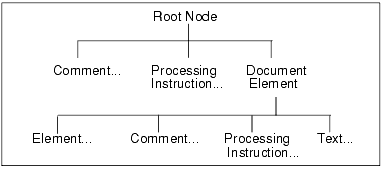
The root node has no actual text associated with it. You can think of the file name as the root node. A document can include zero or more comments and zero or more processing instructions.

A document element is required, and there can be only one. The document element contains all elements in the document. For example:
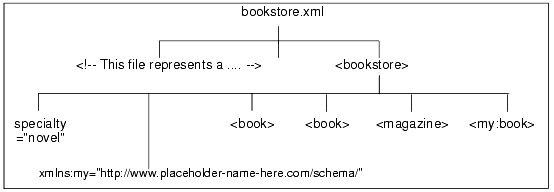
In the preceding figure, bookstore.xml is the name of a file that contains XML data. There is a comment near the beginning of the document that starts with "This file represents a ..." The document element is bookstore. The immediate children of bookstore include an attribute, a namespace declaration (not supported by Stylus Studio), three book elements (one is in the my namespace), and a magazine element. The book and magazine elements contain elements and attributes, which are shown in the figure that appears in Tree Representation of a Sample XML Document.

Stylus Studio Lends a Helping Hand to the New Orleans Reconstruction Efforts

Read how Stylus Studio is helping with the on-going hurricane Katrina reconstruction efforts in New Orleans.

Stylus Studio is a Real Cost-Saver in Novell Implementations

Learn how TriVir, a leading consulting group used Stylus Studio to implement a Novell based solutions using DirXML, eDirectory, and the exteNd suite for their government customers.

XML Schema-Aware Queries and Stylesheets

Learn how to simplify XSLT and XQuery applications using Schema Aware XSLT and XQuery processing technologies.

XPath Generator

Stylus Studio includes an XPath generator that helps you easily create XPath expressions. This page illustrates how you can accomplish this.

Stylus Most Wanted

 
Free Stylus Studio XML Training:
W3C Member
