Overview of Scenario Features

This section describes the main features of Web service call scenarios. It covers the following topics:

Scenario Names

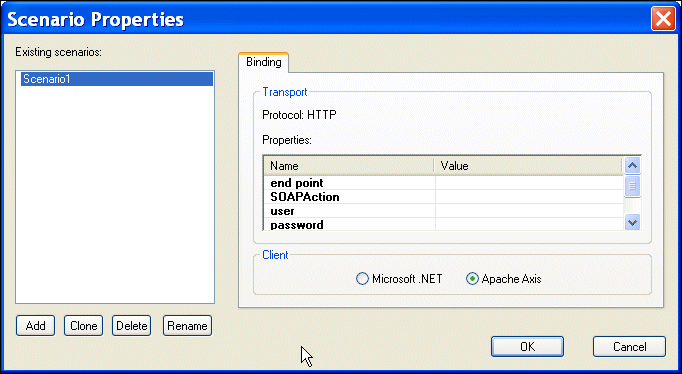
You specify a name for a Web service call scenario on the Binding tab of the Scenario Properties dialog box.

Figure 366. Binding Tab of the Web Service Call Scenario Properties Dialog Box

When you create a Web service call scenario, specify a name that makes it easy to distinguish one scenario from another.

Transport Protocol and Client Settings

You specify the transport protocol you want to use when testing the Web service on the Binding tab of the Scenario Properties dialog box.

When you use HTTP as the transport protocol, the Web service call client can be any one of the following:

  • Microsoft .NET
  • Apache Axis

Other Transport Setttings

Once you specify the client, Stylus Studio displays a list of additional settings that you can use to define properties for the scenario. Some values, such as the time out, are system defaults. Others, such as the SOAP action, are taken directly from the WSDL specified in the Web Service Call Composer.

Note


Values you specify on the Binding tab override those in the WSDL displayed in the Web Service Call Composer.

HTTP Settings

The following table describes the scenario settings associated with the HTTP transport protocol.

Setting
Description
end point
The server on which the Web service is executed. For example: http://glkev.webs.innerhost.com/glkev_ws/WeatherFetcher.asmx.
This value is taken from the current Web service call. Required.
SOAPAction
The SOAP action described by the WSDL you selected for the Web service call. For example: http://www.myasptools.com/GetWeather
This value is taken from the current Web service call. Required.
user
The username used to access the Web service if authentication is required. Optional.
password
The password used to access the Web service if authentication is required. Optional.
time out
The time in milliseconds until the connection to the Web service server is dropped due to inactivity. The default is 300000 (300 seconds). Required.
Table 78. HTTP Settings

Television

Television

Electronics & Electrical Equipment

Many electronics and electrical equipment companies need the most powerful XML IDE to power up their companies. Come see which electronics & electrical equipment companies are wired up with Stylus Studio 2006.

Saxon XSLT Processor

Stylus Studio® has partnered with Saxonica, a leading provider of Java-based XSLT and XQuery processing components to offer a robust XSLT 1.0 and 2.0 development environment, featuring development and deployment using the Saxon XSLT processor.

Learn XQuery in 10 Minutes, by Dr. Michael Kay - An XQuery Tutorial

Learn XQuery in 10 Minutes By Dr. Michael Kay is for all those people who really want to know what XQuery is, but don't have the time to find out. It's the fastest XQuery tutorial on the planet - read it now!

Stylus Most Wanted

 
Free Stylus Studio XML Training:
W3C Member