Viewing an XML Instance

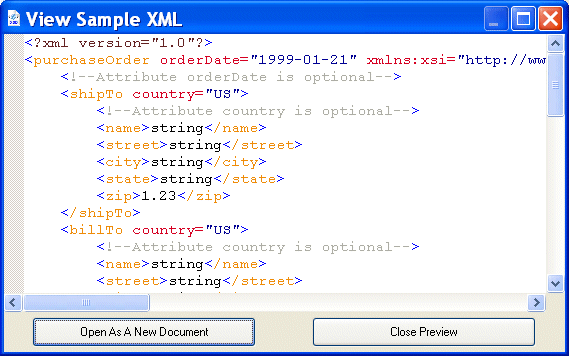
You can view an instance of the XML represented by a node in the XML Schema Diagram tab. You can also optionally create an XML document based on that instance. For example, here is an instance of the XML represented by the purchaseOrder element in purchaseOrder.xsd.

Figure 270. Sample of XML Based on XML Schema

If you want, you can create a new XML document based on this instance by clicking the Open as New Document button.

Note


If the XML Schema contains an element defined using a built-in type, the instance of that element in the XML document is created using the minimum value of the range specified for that type. For example, if the XML Schema contains a <part> element defined as type="xs:integer", the <part> element in the resulting XML document appears as <part>-9223372036854775808</part>.

To view an XML instance:
1. In the Diagram tab, select the node for which you want to see sample XML.
2. Select Diagram > View XML Sample from the Stylus Studio menu.

Alternative: Select View XML Sample from the node's shortcut menu (right-click to display).

The View Sample XML dialog box appears. (See Figure 270.)

3. If you want to open this instance as a new XML document in Stylus Studio, click the Open as a New Document button. Otherwise, click Close Preview.

XQuery Profiler

Stylus Studio's XQuery Profiler allows you to benchmark any XQuery expression, and it helps you locate and eliminate performance bottlenecks for maximum XQuery performance.

XQuery Integration

Learn how new XQuery technologies can simplify legacy data integration by leveraging industry standards, proven open-source XML processing components, and Stylus Studio's integrated XQuery & XML tools.

Map between EDIFACT and X12

Anything can be mapped to anything: EDIFACT to X12 or vice-versa, either to XML, and any of those to flat files or other formats. Both the XSLT and XQuery mappers can help bridge complex formats with ease.

Building Workflow Applications with XML

Learn how to design custom XML workflow applications - from modeling your data and information processes, to capturing input from users in XML, and finally, generating useful queries and reports from the XML data -- using XSLT & XQuery technologies.

Stylus Most Wanted

 
Free Stylus Studio XML Training:
W3C Member