About XML Document Structure

The XPath processor operates on a tree representation of XML data that looks like the following figure:
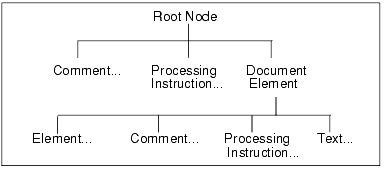
The root node has no actual text associated with it. You can think of the file name as the root node. A document can include zero or more comments and zero or more processing instructions.

A document element is required, and there can be only one. The document element contains all elements in the document. For example:
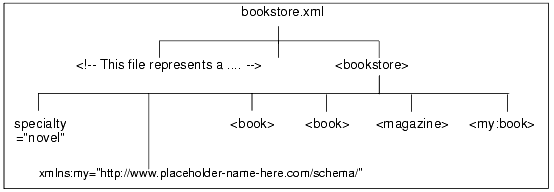
In the preceding figure, bookstore.xml is the name of a file that contains XML data. There is a comment near the beginning of the document that starts with "This file represents a ..." The document element is bookstore. The immediate children of bookstore include an attribute, a namespace declaration (not supported by Stylus Studio), three book elements (one is in the my namespace), and a magazine element. The book and magazine elements contain elements and attributes, which are shown in the figure that appears in Tree Representation of a Sample XML Document.

Apache FOP

Apache FOP is an open-source engine is available from the Apache project that renders XSL-FO into PDF and other popular document formats. Apache FOP is fully integrated with Stylus Studio's XSL:FO tools.

XSL and XSLT Tools

XSLT tools in Stylus Studio let you easily edit, debug, design and profile XSLT stylesheets using a powerful and intuitive graphical user interface.

Database-to-XML Mapping

Stylus Studio features several database-to-XML mapping tools that allow you to easily query a relational database using SQL/XML or SQL and render the results as XML. Stylus Studio also supports the world's first and only visual SQL/XML Editor!

XML Code Folding

Stylus Studio's XML Editor features XML code folding, a powerful and intuitive way to maximize limited screen real-estate and help make sense of large XML files.

Stylus Most Wanted

 
Free Stylus Studio XML Training:
W3C Member
